SmartSaver: Bank Calculator Tool
Developed an analytics decision platform that transforms complex banking data into actionable financial insights, empowering users to optimize their savings strategy through personalized calculations and an innovative fund distribution algorithm.
Task
Conceptualized, designed, and developed a comprehensive banking calculator tool that enables users to compare interest rates and potential returns from different banks, considering multiple qualification criteria.
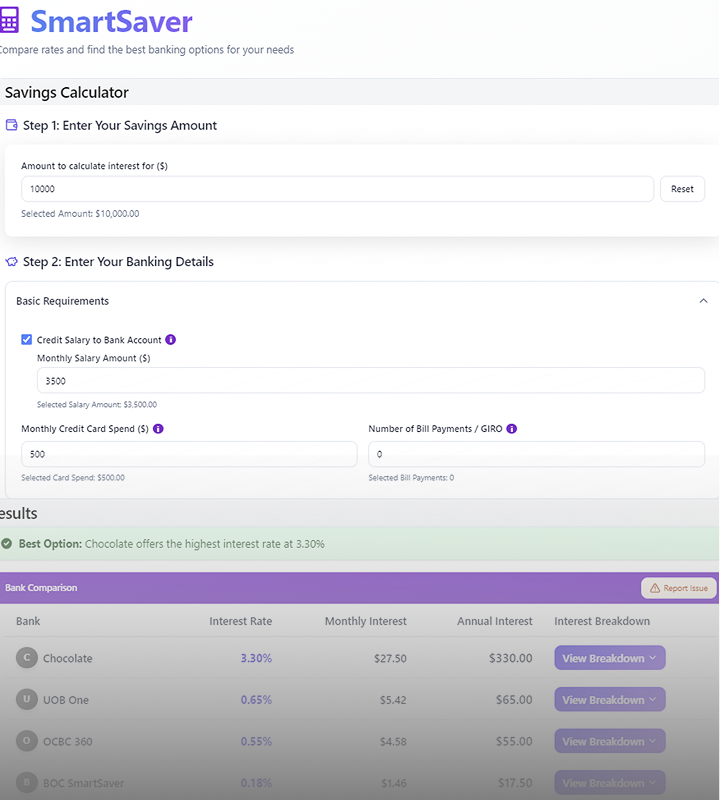
My discovery process began with a key insight: despite the abundance of financial comparison websites, none effectively addressed the multi-variable qualification criteria that determine actual interest returns.
Through structured interviews with 15 potential users across different financial profiles, I uncovered three critical user pain points:
- Calculation Complexity: “I can’t manually calculate all these conditional tiers across different banks.”
- Optimization Challenge: “Should I put all my money in one bank or split it? I have no way to figure this out.”
- Information Asymmetry: “Banks make their interest structures deliberately complicated to prevent easy comparison.”
Competitive analysis revealed most existing calculators only calculate single bank returns without comparative analysis, ignore multi-variable qualification conditions, present raw numbers without actionable insights, and lack fund distribution optimization capabilities.
Through research, I identified four primary user personas:
Based on user research, I developed a clear product vision: “To empower users to make optimal banking decisions through transparent analysis of complex interest structures.”
This vision guided four strategic pillars:
- Comprehensive Analytics Engine: Account for all conditional factors impacting interest rates
- Insight Transformation: Convert complex calculations into clear comparative insights
- Optimization Intelligence: Develop algorithms to determine optimal fund distribution
- Continuous Learning: Collect anonymous usage data to enhance calculations
For feature prioritization, I developed a comprehensive feature set and prioritized it using a value-effort framework, focusing first on high-value, lower-effort features for the MVP, such as the multi-bank interest calculator, side-by-side comparison table, mobile-responsive interface, and basic feedback collection system.
Unlike typical calculators that simply present data, I took an analytics-first design approach focused on transforming raw calculations into actionable insights. This included creating a logical flow from input variables to insight presentation, developing progressive disclosure hierarchy for complex information, and designing a comparative visualization framework highlighting key differences.
The technical architecture was designed to support complex calculations while maintaining performance and scalability:
- Modular Calculation Engine: Separated core calculation logic from presentation layer
- Data Management: Used Supabase for structured storage of rates and criteria
- Performance Optimization: Implemented calculation memoization to improve response time
- Analytics Implementation: Designed event tracking for feature usage patterns
I established a comprehensive measurement framework to evaluate product success, focusing on these primary metrics:
- User Confidence Score: Measured through post-calculation survey
- Decision Time: Time from initial visit to completion of comparison
- Optimization Value: Percentage improvement through fund distribution optimization
- Satisfaction Rating: Post-usage satisfaction survey results
I implemented a robust analytics architecture to measure both usage and impact, with an event tracking framework aligned with the user journey, a feedback collection system, and performance monitoring for calculation response time.
Early results demonstrate significant impact on user financial decision-making:
- 76% of users report increased confidence in their banking decisions
- Average optimization value of 21% through the fund distribution algorithm
- Decision time reduced by 89% compared to manual comparison methods
- 4.7/5 average satisfaction rating from post-usage surveys
User feedback revealed several key insights: transparency drives trust, with users particularly valuing understanding exactly how interest is calculated; the fund distribution optimization feature receives the highest satisfaction ratings; and mobile usage exceeds expectations, with 68% of users accessing the tool via mobile devices and spending 24% more time exploring different scenarios.
SmartSaver has evolved significantly from its initial concept, with each release adding valuable functionality based on user feedback and strategic priorities: